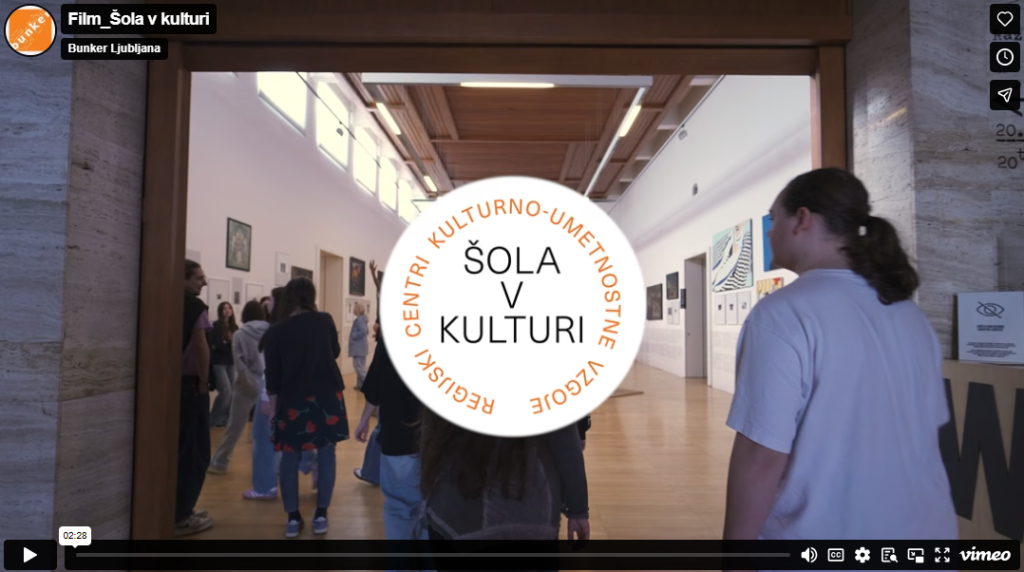
Regional centers of arts education
Over the next four years, five cultural organizations – five partners in five municipalities in five statistical regions of Slovenia – will bring together cultural organizations, educational institutions, local communities, and other stakeholders, such as organizations in the fields of education, tourism, youth organizations, self-employed cultural workers, etc. All these individuals and organizations will be integrated into regional centres of arts education, which will offer children, young people, and teachers high-quality, contemporary, interesting, and accessible arts education in the form of three-day intensive packages – Schools in Culture.
Five regional coordinators will work with the project manager to establish connections within regions, between regions, between artistic fields, and between sectors – all with the aim of establishing lasting partnerships based on integrating the existing, developing the new, and building lasting collaborations and interconnections in the field of arts education.
Education and training will be aimed at all stakeholders involved (cultural coordinators of cultural institutions, local communities, educational institutions, self-employed persons), with an emphasis on the education and training of regional coordinators and expert facilitators who conduct the three-day Schools in Culture. The education and training will consist of lectures and workshops and will also include learning through observation, participation, and mentoring.
All of the partners involved have experience in arts education, ranging from short school visits to in-depth long-term programmes. We have noticed that, despite our efforts, our programmes are not universally accessible (either for financial reasons or reasons related to transportation and various forms of disability; schools are also noticing in some cases that children who are already interested in the field or already involved in it are more likely to participate), that it would be useful to integrate our programmes with many others in the regions, and that children, young people, and educators alike are missing longer, more in-depth formats.
The three-day School in Culture format meets most of the above needs and challenges.
In developing and implementing the Schools in Culture, we will take into account existing programmes, develop and incorporate new ones (both in collaboration with various cultural institutions in the regions), and strive to standardise the format and establish it as a permanent part of the school curriculum, while keeping it flexible – always ready for changes, new topics, new artistic content and connections.
The three-day School in Culture will include several areas of art, several genres and formats, the experience of art, together with mentor-led artistic creation, exploration of the cultural landscape of cities and cultural institutions, as well as guided reflection and critical evaluation. This combination provides an excellent model for the development of cultural and many other competences.
Communication will focus on high-quality and thorough photo and video documentation, recording and archiving, which, together with the materials created by children and young people in media literacy workshops, will form the basis for comprehensive project documentation that will be presented to key target audiences: professionals, decision-makers, all stakeholders involved, and – through the media and selected direct channels (blogs, social networks) – to the general public.
The final international conference and accompanying festival of children’s and youth creativity will serve as a concluding opportunity communicate and disseminate the results.
A three-member expert evaluation team will provide continuous evaluation and guidance on the project, ultimately conducting a final comprehensive evaluation. This evaluation will inform the development of recommendations and a national implementation strategy for the Schools in Culture programme. At the same time, educational institutions will form permanent alliances and permanent commitments to systematic planning of cultural and artistic education in their annual work plans and other strategies.
The overall goal of the project is to establish:
- three-day high-quality, tried-and-tested School in Culture package programmes, combining participation in and experience of art, and covering all three pillars of cultural and artistic education: experiencing art, learning about art, and learning through art. The three-day School in Culture programmes will cover a variety of artistic genres and include at least three different areas of culture, paying special attention to those that are less accessible or less represented in school curricula. This three-day School in Culture programme model will become a permanent feature of school programmes, forming part of annual plans and curricula, as well as the general public’s awareness of the standard educational model;
- qualified regional coordinators with exceptional knowledge of the arts education offer of their region, who will be connected with other regional arts education coordinators, local communities, and all other stakeholders involved in the arts education system—from the Cultural Bazaar to both relevant ministries, the National Education Institute, etc.;
- qualified expert facilitators for the three-day Schools in Culture with the best combination of knowledge and skills from “both worlds” – artistic and educational – as well as organizational drive and motivation for guiding groups and testing new models;
- a high level of cooperation among schools (educational institutions) that will not only test their participation in the School in Culture programme, but will also commit to regular involvement, as well as to the adoption of a strategy or inclusion of arts education in their organization’s development plans. Regional coordinators will be trained not only to developed packages for schools, but also to provide advice on planning of the overall cultural and arts education activities of schools. The long-term goal is to ensure that all Slovenian primary and secondary schools regularly implement three-day School in Culture
By the end of 2029, regional centres of arts education will have established stable partnerships with a tried-and-tested Schools in Culture package offering that will be established as a regular standard in primary and secondary schools.
Partnerships in regional arts education centres will extend beyond regional and arts education-specific cooperation to encompass interregional and national collaborations and partnerships, expanding into areas such as family cultural activities, tourism, and adult education.
Five pilot regional arts education centres will serve as a model for the establishment of regional arts education centres throughout Slovenia, operating on the basis of recommendations from the established national strategy.

Project partners
Partner cities: Ljubljana, Maribor, Celje, Novo mesto in Koper
- Bunker, Ljubljana / Central Slovenia Statistical Region
- Maribor Art Gallery / Drava Statistical Region
- Celje Regional Museum / Savinja Statistical Region
- Central Library Srečko Vilhar Koper / Coastal–Karst Statistical Region
- Novo mesto Institute / Southeast Slovenia Statistical Region
contacts:
Central e-mail: kuv@bunker.si
Bunker, Ljubljana / Central Slovenia Statistical Region: maja.vizin@bunker.si
Maribor Art Gallery / Drava Statistical Region: brigita.strnad@ugm.si
Celje Regional Museum / Savinja Statistical Region:
solavkulturi@pokmuz-ce.si
Central Library Srečko Vilhar Koper / Coastal–Karst Statistical Region: ursa.skumavc@knjiznica-koper.si;
kuv@knjiznica-koper.si
Novo mesto Institute / Southeast Slovenia Statistical Region: sandra.hrovat@znm.si